
Peace Pole, Community Center-Garden by Koreatown, LA, California, USA.
Submitted on May 9, 2026
Event: January 2026
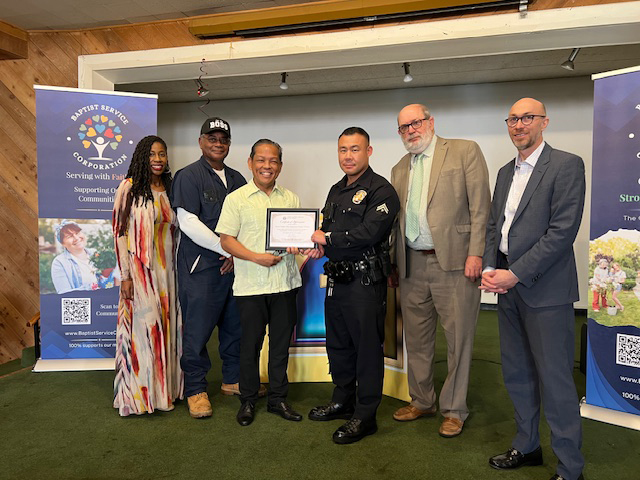
Baptist Service Corporation press conference attendees, from left, are Dr. Mary Ann Ross, James Johnson, Gerald G. Gubatan, Alexander Cho, David McFadden, Bill Rosenberger
A six-foot, bright-white Peace Pole and a 3-foot lemon-yellow garden shovel are the newest symbols of change near Koreatown.
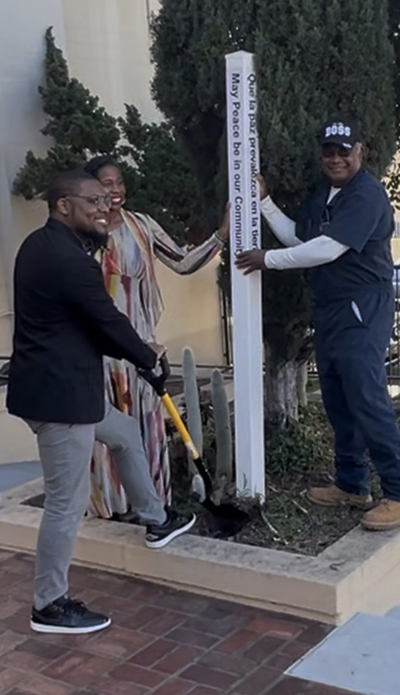
They stand on the grounds of the First Baptist Church of Los Angeles but will play a key role in changing lives for miles around central Los Angeles, thanks to the work of the Baptist Service Corporation (BSC) and the organizations it partners with.
“A Peace Pole reminds anyone that you can have safety and dignity,” said the Rev. Eddie Anderson at the press conference where the BSC held a ceremonial groundbreaking for a new community garden, marked by the shining shovel and newly erected Peace Pole. Anderson, the chief executive officer of Partnership for Growth LA, which partnered with BSC to install the Peace Pole, explained the monument’s importance.
Peace Pole and Community Garden ceremonial groundbreaking. (Courtesy photo)
“Peace Poles are rare in our world. They remind us through symbolism. They are markers on your journey so that if you find yourself homeless, trying to make it in Los Angeles, or coming from a different background, you can remind yourself that in this city, you belong. A Peace Pole says you belong here,” Anderson said.
The peace pole is one of more than 200,000 such monuments around the world, inscribed with the words “May Peace Prevail On Earth” or similar messages. The inscriptions are often written in English, Spanish, French, Arabic, Japanese and even American Sign Language.
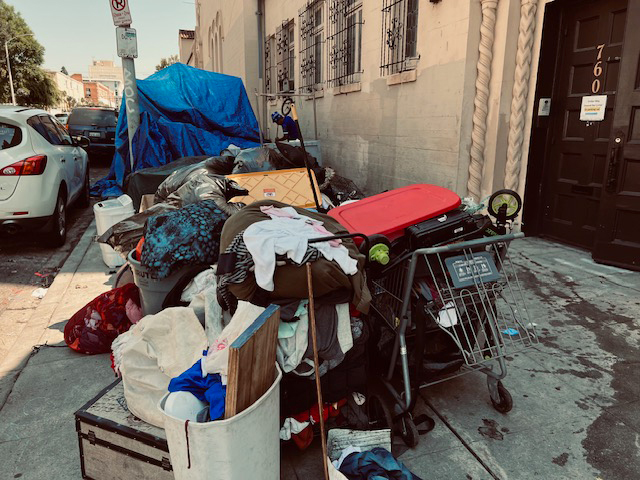
Archive photo of encampment outside of First Baptist. (Courtesy photo)
The movement began in the 1950s as a call for peace following World War II and later expanded to include charitable efforts for people in need. Today, Peace Poles are located in more than 200 countries, as well as on military bases, including the Pentagon.
If the Peace Pole serves as a beacon to the destitute, one thing visitors are sure to find at First Baptist in the coming months is a harvest of cucumbers, carrots, tomatoes and other produce planted this week by Jubilee Build Co. Workers from Jubilee Build will transform a fenced-in strip of soil on the south side of the historic church — once guarded by a machete-wielding unhoused woman — into a community garden.
The area along Eighth Street, between South Westmoreland and Magnolia avenues, was once a gauntlet of rickety tents, rusted shopping carts, piles of debris and drug-littered syringes. That began to change last year when Dr. Mary Ann Ross took over as executive director of BSC.
“Dr. King once stated that everyone can be great because everyone can serve,” Ross said at the press conference, which was timed to coincide with the Martin Luther King Jr. holiday weekend.
“Part of Dr. King’s legacy as a Baptist preacher was collaboration, unity and tolerance. For such a time as this, our garden represents unity, collaboration and tolerance. One of the things we’re going to do is give back to the community by sharing our first fruits with food pantries that have been depleted due to economic stress and the loss of SNAP benefits for many residents in the area,” she added.
Ross worked with the city council, police gang units and community leaders to push the Mara Salvatrucha, or MS-13, street gang out of the neighborhood, eliminate homeless encampments and reinvigorate community pride.
At the same time, she is repurposing the church’s 16,000-square-foot basement to house social services and community support organizations, including the Koreatown Youth Community Center, the Karsch Center and Para Los Niños.
Known as the Good Neighbor Center, the expansive space is already outfitted with a large conference room, an appliance-filled kitchen and a cavernous multipurpose event area. One room is filled with donated clothing reserved for formerly incarcerated people transitioning back into the community.
Guest speaker Apostle Jennifer Chapman, who delivered a spiritual message from San Jose, said the church’s efforts are essential.
“It is very important for the community to come out of their doors, come out of isolation and begin to receive love,” Chapman said.
“This is a manifestation in the spiritual realm that is taking place in the natural realm. First, it’s spiritual, then natural, and then it will go spiritual again — to reap the souls and the harvest of the people in the community and, ultimately, the nation.”
(Jay Jackson/L.A. Sentinel)